Showing posts with label Citi Field. Show all posts

Friday, April 15, 2011

How Jackie Robinson Impacted New York


Going into the third year of Citi Field’s existence, the beautiful park in Willets Point/Flushing has been maligned with controversy. It’s been soaked with snark and populist anger; the financial crisis that crippled Citibank made the moniker “Taxpayer Field” stick for a few weeks in the local media as the financial services company received TARP funds. It has also been lambasted as another publicly-funded stadium; though the Yankees were a larger target, the Mets didn’t exactly escape criticism for taking public funds to build its new home. Yet, there’s another critique that sticks out as peculiar and that’s for the homage paid to arguably the most important sports figure in American history, Jackie Robinson.

There were some people, even friends, who questioned why the Mets paid a significant and permanent homage to a man who never played for them (and in a twisted turn, giving respect for a franchise that left for Los Angeles). They felt that retiring “42” throughout baseball was the ultimate honor; one that would have deemed any other permanent remembrance unnecessary. However, Fred Wilpon – owner of the Mets – is known as much for his reverence for the Brooklyn Dodgers era and New York’s National League heritage as he has become notorious for his and his team’s current financial issues. No matter what can be said about the stewardship of the Mets over the years, he openly embraced the city’s other baseball history when Citi Field was built.

He knew that the legacy of Robinson is in the DNA of New York.

As sports fans have learned over the last century, New York City, not just the borough of Brooklyn, is a place that has no problem telling you it demands, rather expects winning. [NOTE: For those who haven’t heard, Brooklyn is a rather proud borough. To this day and certainly on this day, many Brooklynites are celebrating Robinson as one of their own. And he was.] It’s not exactly unlike any other city or town with a franchise built on ticket sales, merchandise and television. Yet, even if we don’t admit it as a whole, NYC demands some overt personality and work ethic en route to absolute dominance. We want alpha males that define leadership, even if it doesn’t always work. We want offensive flair and pizzazz though defense made a few of our teams into contenders and champions. Most of all, we don’t care where you came from or where you might decide to live during the season, but we want you to be one of us while you’re here.

The thing about Robinson and his Dodgers was while they became the most progressive sociological experiment – three more black players came to the fold after Robinson, including Roy Campanella – success on the diamond wasn’t easy in a city where there’s always another team to be compared to (or in those days, two). The Dodgers were much more successful than their rival Giants, whose questionable management and ownership almost wasted the talents of Willie Mays (almost). Yet, the Yankees were… the Yankees.


The battles between the teams in seven World Series (six with Robinson on the team) were reflections of a contrast between fan bases and adopted ideologies, even if reality may have differed. What you think of the Yankees now is what people thought of in the 1940s & 50s: more Upper East Side & Wall Street than Mott Haven and Fordham Road, rich, stodgy, arrogant, lily-white, yet head and shoulders better than all comers. The Brooklyn Dodgers were the ideal opposite in every way, even though putting a baseball team on equal financial standing with butcher shops or grocers is a huge stretch. The fact that the Dodgers spurred integration in professional team sports gave Brooklyn a colored stitch in its flag that it waved to the world.

Robinson represented a new direction for the sport, but his presence in New York was a challenge for a city that calls itself a melting pot. The country’s population as undergoing significant shifts as the First Great Migration had found blacks settling and developing roots in the North. During his time with the Dodgers, the Second Great Migration found African-Americans spreading out further across the country, but still seeking employment in New York. Always a destination for European immigrants, NYC‘s population began to swell and “brown” a bit. The Migrations allowed Southern-born blacks to grow roots into the city while waves of Latinos made their way to the Boroughs as well. Truth be told, no matter how open New York claimed to be, these new residents clashed with the mainstays; causing racial tensions before, during and after Jackie.

What Robinson did, however, was prove the old adage about sports; we love you as long as you’re winning. From his first World Series appearance as a rookie to garnering MVP honors in 1949, Robinson was a true franchise player that owner Walter O’Malley (yes, I said his name here) and general manager Branch Rickey built around. His accolades speak for themselves, but above it all, a stubborn dignity to face the venom on and off the field made Robinson a black public icon where few existed. This especially matters because as New York City was telling the world it was open for business in pre-World War II times, it had an extremely difficult time embracing ethnic diversity within its ports.

There’s no question that Jackie Robinson was more than a baseball player; on a national scale, he remains the most transcendent African-American athlete in the history of team sports. However, in terms of his importance to New York City – not just Brooklyn – how his presence impacted the city’s racial dynamics could and should never be forgotten. We take that for granted in this modern metropolis; generations of New Yorkers never witnessed overt and wide-scale racial strife, though we are certainly aware that racism is alive and real.

Though it’s far too late to change the permanent honors bestowed by Wilpon and the Mets, I hope they don’t even consider altering or removing one brick of the glorious Rotunda. I hope the larger-than-life “42” stands tall, waiting for more baseball fans (Mets or otherwise) to take pictures with and admire. I hope the footsteps casted in his memory remind each visitor to Citi Field that each one of us can cast our own for better days ahead. I hope those who still question why a Dodger is revered in Mets territory can take a glance at the still-changing ethnic diversity of the fans inside the stadium and say, “now, I get it.”

Thank you, Jackie.


Say What?!?!: I live next to Jackie Robinson Park here in Harlem; a 12.77 acre, ten-block gem that’s been through hell and back over the years. What used to be called Colonial Park was the last place you wanted to be during the day, let alone at night. It was renamed in Robinson’s honor in 1978; the midst of some of Harlem’s darkest days. It took far more than a name change to clean up JRP, rather two decades of persistence and championing to bring it from the brink. The Park has been a part of my family’s history for close to 20 years as we’ve been a part of its revitalization.

I mention this because at its northern end borders the former home of the final version of the Polo Grounds where Willie Mays once roamed. There was likely consternation about naming the Park in Robinson’s honor, but you couldn’t tell around these parts. The Giants may have called Harlem home before leaving for San Francisco, but in this community, Robinson and Mays were teammates in a far different game than the one on the diamond.
Thursday, April 16, 2009

Citi (II)

And so with every ballpark having officially opened for the new season, it's that time again for your favorite Scribe to see what these cathedrals to the game of baseball have to offer.

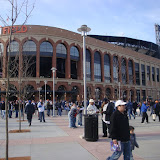
Just over a month after walking around this place, Stephon Johnson and I finally walk through the $800 million halls of Citi Field. It's safe to say that Keyspan Park in Brooklyn (a very nice minor league piece of real estate for the Mets' Single-A affiliate Cyclones) has been surpassed as the best ballpark in New York City.

Yes, I know. I haven't gone inside the new place on 161st Street in the Bronx, but that will come fairly soon.

Meanwhile, beacuse so much video was taped along with the pictures, there are two clips followed by a slideshow of the particular features of Citi Field.

With that said, before anyone asks again, NO, this park was not built on TARP funds. In fact, it was built on from New York State and City tax coffers, thank you very much.

Yes, same difference.


Citi Field - Jackie Robinson Day

Hopefully you will take the opportunity to head out to Flushing for a game after seeing this post. As for the second park on the docket this week, you'll get a glimpse this Saturday.

I'll give you a hint: it's not the other one here in New York. See you then!

Tuesday, April 14, 2009

Citi

This is going to be a heck of a four-day stretch.

Tomorrow night for Jackie Robinson Day, yours truly will be at Citi Field, where the home team will formally dedicate its Rotunda in honor of the legendary second baseman.

Ah, new stadium smell. Must be nice.

Saturday afternoon, Scribe will be... well, you'll find out soon enough.

If you haven't followed Scribe's previous looks around the new digs for the Metropolitans, check out what's below here. If you have, just enjoy it again.

CitiField

Citi Field Update


If there are any particular views or quirks you want to see a new picture or part of the video on, leave a comment below or email me at asportsscribe@gmail.com.

Sunday, March 15, 2009

Almost (I)

Just over a decade ago, Brandy had a song (covered by country artist Mark Wills later in 2000) that reminded us that Almost Doesn't Count. Well, here on Scribe, consider this video an exception.

(Yeah, I know what you're thinking: He just referred to Ray J's sister.)

Yesterday, along with Stephon Johnson, we took a trip to the new home of the New York Mets (Citi Field) while paying a slight homage to its former and suddenly, more-revered home (Shea Stadium).

Now, for those of you who have been parusing the internet for reflections of Shea and glimpses of Citi, you've certainly seen better looks. Yet, you're looking here because... well, at least someone's having fun with it.


Season-ticket tours

Ticket sales for only April and May as of this post.

While Ken Belson and Richard Sandomir of the New York Times heap the positives...

John Koblin of the New York Observer is not so fond of Citi. Thoughts?

Citi's Wiki.
Oh, and a note about the Home Run Apple: you saw it sitting in the centerfield/bullpen gate. Apparently, that will be the permanent home of the original as there will be a new Apple erected in the new outfield bleachers.

The latest from the new Yankee Stadium coming next.

Monday, February 16, 2009

Fraudulent

No, no, this isn’t about a player. Sorry to disappoint.

This is about an ongoing story from the business world is that of Stanford Financial.

In the wake of the Bernie Madoff scandal and the controversial Troubled Asset Relief Program (a.k.a. The Bailout), Stanford Financial has undergone some intense scrutiny, though outside of the business media, there is little traction gained from this story. Stanford is being investigated by the Securities Exchange Commission (SEC) as well as the FBI for dealings through its offshore bank in Antigua. The SEC is trying to determine how Stanford can sell CDs (certificates of deposit) that offer yields of twice the industry average when many assets that the company invests in have rapidly eroded in the last two years.

Even though the alma mater provided a tremendous business education, I can still claim to be a complete idiot in the realm of finance, so it would be unfair to burden you with any more details without the wisdom or savvy to walk you through it.

Why is this important to Scribe?

BusinessWeek’s Unstructured Finance blog has been following this news closely along with its originator, the Wall Street Journal, Reuters, Bloomberg and all other important business media. Matthew Goldstein brought up Stanford’s sports marketing deals; most notably its arrangement with one of the best golfers in the world, Vijay Singh.

“One can only imagine how professional golfer Vijay Singh is feeling in the wake of the news that securities regulators and other federal authorities are investigating Texas-born billionaire R. Allen Stanford’s fast-growing financial services firm.
In January, Singh, one of the world’s top-ranked golfers, inked a marketing deal with the 58-year-old financier’s Stanford Financial. In return for an undisclosed sum of cash, Singh agreed to make the Houston-based company’s golden eagle logo the main brand appearing on his apparel clothes and golf bag. Trade publication Street & Smith’s Sport Business Journal, which first reported the deal, said the arrangement is expected to last up to five years.
The deal with Singh is just another in a string of high-profile sports marketing arrangements that Stanford Financial has struck in the US and in the Caribbean island nation of Antigua, where the firm’s controversial offshore bank, Stanford International Bank, is located. Allen Stanford has used the sports marketing deals to raise the international profile of his $50 billion firm and help attract wealthy buyers for the high-yielding certificates of deposit issued by its offshore bank.”
Recently, there was news that Citigroup, the naming rights holder for the new baseball field for the New York Mets, may consider severing their deal with NYC’s National League club to halt a simmering public relations disaster as it is one of the companies currently accepting bailout money from the American government. Whether or not Citi Field will remain as such remains to be seen (as of now, it will), however, it appears that for the second time this decade, sports sponsorships are coming into the forefront because of maligned (at best) companies.

It was between 2000 and 2002 that several high-profile accounting and securities fraud scandals broke out; the most notorious of all belonging to Enron. Before the house of cards fell, the Houston-based company purchased the naming rights – a thirty-year, $100 million deal – to the new ballpark for the Astros in 1999. It was Chairman and CEO Kenneth Lay who threw out the ceremonial first pitch in the building’s history. Of course, when the company was investigated by the SEC for irregular accounting practices (along with the former Arthur Andersen), the Astros relinquished the naming rights as a result of the public relations nightmare this scandal had become. The death of Enron Field gave way to the current Minute Maid Park, nicknamed the Juice Box.

Enron was not the only fraudulent company with naming rights as Adelphia Communications had a deal with the Tennessee Titans for what is now known as LP Field in Nashville. The cable company, once the fifth largest in the United States, also brokered their deal in 1999 after the team moved across the state from their temporary home in Memphis to start their after-Houston Oilers life. The Rigases (father John and sons Timothy and Michael) had hid $2.3 billion in liabilities from their books and apparently used the funds for personal gain. In the sports realm, what makes this scandal worse than Enron or Citigroup is that not only was John Rigas the majority owner of the Buffalo Sabres, but Adelphia created a regional sports network and a sports radio station in western New York.

That era produced several notorious naming rights and sponsorship fiascos evidenced here as many companies went belly-up because of corrupt management or overinflated value leading to the dot-com bust. You would think that history wouldn’t repeat itself so soon.

Unfortunately for some teams, individual athletes and leagues, they have to contend with these business calamities as their partners seem to bring more trouble than these long-term deals may be worth. Now with the current climate from Wall Street to 150th Street to everywhere else besides Main Street, the sports world has to be asking itself “is there anybody on the up-and-up?” Even more, the companies looking to sports as a promotional avenue (and an ego-booster of immense proportions) are becoming more wary of doing so to avoid the perception of having their more-than-ever finite cash flow invested somewhere not so feasible to the public.

And so, I pose this to all, regardless of your background: should companies cut back or eliminate their sports marketing programs?

Also, check the poll on the right.