Showing posts with label Jackie Robinson. Show all posts

Friday, April 15, 2011

How Jackie Robinson Impacted New York


Going into the third year of Citi Field’s existence, the beautiful park in Willets Point/Flushing has been maligned with controversy. It’s been soaked with snark and populist anger; the financial crisis that crippled Citibank made the moniker “Taxpayer Field” stick for a few weeks in the local media as the financial services company received TARP funds. It has also been lambasted as another publicly-funded stadium; though the Yankees were a larger target, the Mets didn’t exactly escape criticism for taking public funds to build its new home. Yet, there’s another critique that sticks out as peculiar and that’s for the homage paid to arguably the most important sports figure in American history, Jackie Robinson.

There were some people, even friends, who questioned why the Mets paid a significant and permanent homage to a man who never played for them (and in a twisted turn, giving respect for a franchise that left for Los Angeles). They felt that retiring “42” throughout baseball was the ultimate honor; one that would have deemed any other permanent remembrance unnecessary. However, Fred Wilpon – owner of the Mets – is known as much for his reverence for the Brooklyn Dodgers era and New York’s National League heritage as he has become notorious for his and his team’s current financial issues. No matter what can be said about the stewardship of the Mets over the years, he openly embraced the city’s other baseball history when Citi Field was built.

He knew that the legacy of Robinson is in the DNA of New York.

As sports fans have learned over the last century, New York City, not just the borough of Brooklyn, is a place that has no problem telling you it demands, rather expects winning. [NOTE: For those who haven’t heard, Brooklyn is a rather proud borough. To this day and certainly on this day, many Brooklynites are celebrating Robinson as one of their own. And he was.] It’s not exactly unlike any other city or town with a franchise built on ticket sales, merchandise and television. Yet, even if we don’t admit it as a whole, NYC demands some overt personality and work ethic en route to absolute dominance. We want alpha males that define leadership, even if it doesn’t always work. We want offensive flair and pizzazz though defense made a few of our teams into contenders and champions. Most of all, we don’t care where you came from or where you might decide to live during the season, but we want you to be one of us while you’re here.

The thing about Robinson and his Dodgers was while they became the most progressive sociological experiment – three more black players came to the fold after Robinson, including Roy Campanella – success on the diamond wasn’t easy in a city where there’s always another team to be compared to (or in those days, two). The Dodgers were much more successful than their rival Giants, whose questionable management and ownership almost wasted the talents of Willie Mays (almost). Yet, the Yankees were… the Yankees.


The battles between the teams in seven World Series (six with Robinson on the team) were reflections of a contrast between fan bases and adopted ideologies, even if reality may have differed. What you think of the Yankees now is what people thought of in the 1940s & 50s: more Upper East Side & Wall Street than Mott Haven and Fordham Road, rich, stodgy, arrogant, lily-white, yet head and shoulders better than all comers. The Brooklyn Dodgers were the ideal opposite in every way, even though putting a baseball team on equal financial standing with butcher shops or grocers is a huge stretch. The fact that the Dodgers spurred integration in professional team sports gave Brooklyn a colored stitch in its flag that it waved to the world.

Robinson represented a new direction for the sport, but his presence in New York was a challenge for a city that calls itself a melting pot. The country’s population as undergoing significant shifts as the First Great Migration had found blacks settling and developing roots in the North. During his time with the Dodgers, the Second Great Migration found African-Americans spreading out further across the country, but still seeking employment in New York. Always a destination for European immigrants, NYC‘s population began to swell and “brown” a bit. The Migrations allowed Southern-born blacks to grow roots into the city while waves of Latinos made their way to the Boroughs as well. Truth be told, no matter how open New York claimed to be, these new residents clashed with the mainstays; causing racial tensions before, during and after Jackie.

What Robinson did, however, was prove the old adage about sports; we love you as long as you’re winning. From his first World Series appearance as a rookie to garnering MVP honors in 1949, Robinson was a true franchise player that owner Walter O’Malley (yes, I said his name here) and general manager Branch Rickey built around. His accolades speak for themselves, but above it all, a stubborn dignity to face the venom on and off the field made Robinson a black public icon where few existed. This especially matters because as New York City was telling the world it was open for business in pre-World War II times, it had an extremely difficult time embracing ethnic diversity within its ports.

There’s no question that Jackie Robinson was more than a baseball player; on a national scale, he remains the most transcendent African-American athlete in the history of team sports. However, in terms of his importance to New York City – not just Brooklyn – how his presence impacted the city’s racial dynamics could and should never be forgotten. We take that for granted in this modern metropolis; generations of New Yorkers never witnessed overt and wide-scale racial strife, though we are certainly aware that racism is alive and real.

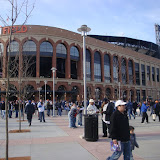
Though it’s far too late to change the permanent honors bestowed by Wilpon and the Mets, I hope they don’t even consider altering or removing one brick of the glorious Rotunda. I hope the larger-than-life “42” stands tall, waiting for more baseball fans (Mets or otherwise) to take pictures with and admire. I hope the footsteps casted in his memory remind each visitor to Citi Field that each one of us can cast our own for better days ahead. I hope those who still question why a Dodger is revered in Mets territory can take a glance at the still-changing ethnic diversity of the fans inside the stadium and say, “now, I get it.”

Thank you, Jackie.


Say What?!?!: I live next to Jackie Robinson Park here in Harlem; a 12.77 acre, ten-block gem that’s been through hell and back over the years. What used to be called Colonial Park was the last place you wanted to be during the day, let alone at night. It was renamed in Robinson’s honor in 1978; the midst of some of Harlem’s darkest days. It took far more than a name change to clean up JRP, rather two decades of persistence and championing to bring it from the brink. The Park has been a part of my family’s history for close to 20 years as we’ve been a part of its revitalization.

I mention this because at its northern end borders the former home of the final version of the Polo Grounds where Willie Mays once roamed. There was likely consternation about naming the Park in Robinson’s honor, but you couldn’t tell around these parts. The Giants may have called Harlem home before leaving for San Francisco, but in this community, Robinson and Mays were teammates in a far different game than the one on the diamond.

Monday, February 22, 2010

Can't Paucity Be a Result of Choice? - Lack of Black Baseball Players Isn't Just Systematic

Many arms will be raised and eyes will be rolled once again after Hank Aaron cried about the lack of African-American players in Major League Baseball.

OR

Many fingers will be pointed and damnations will be had once again after Hank Aaron voiced his concern about the lack of African-American players in Major League Baseball.

Next to PED/steroid use among players and the disparity of payrolls, this is arguably the sorest topic within the baseball community. It’s the sorest topic within this country’s borders, let alone its sports. The mere mention of black and lack sends us some folks into a blind rage; giving reason to post pseudo-anonymous incendiary comments online or craft coded messages in other visual media. They also rile up other folks who seem to wake up in the morning looking to be… well, riled up against anything that feels or looks wrong, even if the truth reveals something more.

There have been thousands of conversations about the lack of black baseball players; most, if not all can be cupped into one of the following opinions, theories and realities:
  • Black families are unable to afford the commitments to the game: purchasing equipment, traveling, insurance (more of an institutional question than familial), etc.
  • Black families have their priorities out of whack: they can “somehow” buy a Playstation 3, the new Kobes and some new rims, but still get welfare money and don’t eat.
  • Baseball lacks new black superstars to make young kids pay attention: After Jackie & Larry broke the color line, Mays & Aaron carried the torch and passed it on to Jackson and Morgan, Griffey Jr. and Bonds, Jeter and… and… There’s no one to hand it to.
  • Baseball carefully opened the gates to Latino players because black players were getting a bit full of themselves.
  • For municipalities, it’s easier and cheaper to maintain a basketball court than a baseball field.
  • These kids look for the instant gratification and the dollars in basketball and football; don’t appreciate the hard work to play this game.
Many of us fans and media share at least one of these concerns/excuses. They are convenient to return to every time this comes up because some want to ignore it and some want to force institutional changes.
The thing about progress is that at some point, fighting for and gaining the right to participate in something would eventually lead to future generations having the chance to do what couldn’t be done before.

In the case of baseball, progress led to the idea that black kids just may not be interested in the game.

Jason Heyward,
Top Rated Prospect in Baseball
Photo Credit to AJC
One of the more irksome, but unmentioned aspects of the paucity of African-American players in the game is that the game’s caretakers have this assumption that a finite number of available young athletes must become baseball players. This paucity would be even more glaring if this was 1970; where the sport dominated in the media (especially TV where there were just three networks and cable just came to the mainstream) and the population was 2/3 of what it is today (200+ million Americans).

Yet, this is 2010.

A black President was inevitable. A black man winning an Olympic gold medal in SPEEDSKATING was unfathomable… because you probably didn’t know it was a sport until last week.

Entertainment options are aplenty, to the point that kids don’t really know what to do with themselves. Yes, technology is the sticking point for curmudgeons and sociologists alike, but in terms of sports, there seems to be a new game cropping up somewhere in the world every other day. We’re fascinated by curling because most of us are trying to understand what makes it a sport, better yet an Olympic sport. Alongside the ‘traditional’ sports are all these ‘fringe’ sports that have grown in profile over the past twenty years.

We also have the same diversity in other realms of entertainment; especially for kids without an athletic bone in their bodies. There’s something for everyone in 2010 and the offerings continue to grow, even as the Great Recession takes hold on the world.

Look, considering this country’s racial history, the dearth of black baseball players – superstars or career minor leaguers – is painful to look at. In the face of the NFL and NBA, where the black populations mirror little else in this country, baseball’s stewards will never live this down. However, there will continue to be people who say that baseball is losing black athletes to these other sports and entertainment outlets.

No sport, no company, no one… is guaranteed to anyone in the population for its future. That sense of entitlement doesn’t help the cause.

Baseball is still a great sport and fans who truly love it will embrace whoever suits up in their uniforms. They’ll embrace any player on the roster as long as they help their teams win, even if they harbor uneasy sentiments about social issues in sports.

What they won’t embrace is a long-term debate on this issue. For all the great programs Major League Baseball has initiated to strum up interest in the game within the black community, what they need to do more than anything else is to understand the realities of 2010. Understand that promoting African-American stars, hosting tournaments in urban communities and merchandising itself onto the heads of kids across the country just may not be enough to interest every black child in America.

And that’s okay.

Past generations fought for so much to ensure that kids of all ethnicities can look forward to how they will participate in society. As the son of parents who have done as such, it’s not lost on me at all that men such as Aaron would love to see greater validation of that blood, sweat, tears and big flys hit so long ago. Yet, I also hope that it’s understood that arguably the greatest aspect of their legacy lies in the fact that millions of children who came after them were allowed another sort of opportunity; to look at the game in a different prism on its own merit…

And respectfully say thanks, but no thanks.

Thursday, April 16, 2009

Citi (II)

And so with every ballpark having officially opened for the new season, it's that time again for your favorite Scribe to see what these cathedrals to the game of baseball have to offer.

Just over a month after walking around this place, Stephon Johnson and I finally walk through the $800 million halls of Citi Field. It's safe to say that Keyspan Park in Brooklyn (a very nice minor league piece of real estate for the Mets' Single-A affiliate Cyclones) has been surpassed as the best ballpark in New York City.

Yes, I know. I haven't gone inside the new place on 161st Street in the Bronx, but that will come fairly soon.

Meanwhile, beacuse so much video was taped along with the pictures, there are two clips followed by a slideshow of the particular features of Citi Field.

With that said, before anyone asks again, NO, this park was not built on TARP funds. In fact, it was built on from New York State and City tax coffers, thank you very much.

Yes, same difference.


Citi Field - Jackie Robinson Day

Hopefully you will take the opportunity to head out to Flushing for a game after seeing this post. As for the second park on the docket this week, you'll get a glimpse this Saturday.

I'll give you a hint: it's not the other one here in New York. See you then!

Tuesday, April 14, 2009

Citi

This is going to be a heck of a four-day stretch.

Tomorrow night for Jackie Robinson Day, yours truly will be at Citi Field, where the home team will formally dedicate its Rotunda in honor of the legendary second baseman.

Ah, new stadium smell. Must be nice.

Saturday afternoon, Scribe will be... well, you'll find out soon enough.

If you haven't followed Scribe's previous looks around the new digs for the Metropolitans, check out what's below here. If you have, just enjoy it again.

CitiField

Citi Field Update


If there are any particular views or quirks you want to see a new picture or part of the video on, leave a comment below or email me at asportsscribe@gmail.com.

Tuesday, June 10, 2008

Leading

There was a moment last week that older generations never thought they would witness, that younger generations had a hopeful cynicism and that future generations just might take for granted one day. Some of us may recall bussing, hoses on full blast and civil protests turning violent. Some of us recall riots across the country, the tense initial days of affirmative action and Fortune 500 executives having foot-in-mouth disease. Nearly all of us can recall one of the most damning statements ever made against a sitting President by an entertainer not known for tact.

Yet, June 3 will forever be remembered as the day a minority candidate – an African American by the name of Barack Obama – became the presumptive Democratic nominee for the Presidency of the United States.

The day has a tremendous historical and emotional context within nearly every person that has a connection with those very memories mentioned. Folks will remember where they where and what they were doing when Obama secured all of the necessary ‘superdelegates’ over Hillary Clinton, who tried desperately to become the first female candidate. In years to come, they’ll give you the first image or thought or word that came to mind when the news was made.

Yet, at top of mind, this poster came up.


It’s a poster that had been plaster throughout the New York City subways stations and along the sides of buses, promoting the grand opening of the Sports Museum of America (credit to the Gate Worldwide, the Museum’s agency of record). It takes a moment that no one in 1947 ever envisioned seeing in their lives – Jackie Robinson, the first black man to play Major League Baseball, shaking the hand of one of his white teammates, Duke Snider – and reminds a sports-hungry public how painstakingly slow social progress was.

Obama’s nomination reminds us of slow it still has been.

The words of this poster frame more than its left side, but it frames a reality that was also hard to fathom. The idea that a professional athlete – one who made a living playing a game – could make country think more about its fundamental flaws than the leaders they elect was unheard of. Sports for public pleasure are littered throughout recorded history, but in the United States, organized professional sports are just over a century old. The specialized media coupled with the finances they garner gives professional athletes an instant platform for anything – good, bad or in between – they say and do. It’s why despite the unwanted attention that some athletes are currently getting (say, Cedric Benson), you will always remember the names of Robinson, Muhammad Ali, Arthur Ashe, Jack Johnson and countless others. You may remember another athlete, such as the one below.


When was the last time you stood up and took notice of a local, state of federal politician while in office?

Regardless of political leanings or ambivalence, we should recognize Obama’s achievement as a long overdue, but significant moment in our nation’s history. However, we should also keep in mind that he nor John McCain, the Republican nominee, have yet to give us that defining moment in action that will reshape our lifestyles. Not to say that it won’t happen, but to watch an ideal come to life is going to take more than nominations and campaigns.

A lot more.

Say What?!?!: Respect due.